 Add to Chrome
 Add to Firefox
 Add to Edge
Scaling World-Model Reinforcement Learning Through Diffusion Policy Optimization
May 25, 2026
Model-based reinforcement learning (RL) can be effectively supported at scale through the use of world models. However, in practice, scaling such approaches remains fundamentally limited. A commonly recognized challenge is model bias and error compounding, which degrade long-horizon predictions. Beyond these issues, we identify a more critical yet underexplored bottleneck: a structural misalignment between search and value learning in existing world model approaches. In particular, policy improvement often relies on value functions induced by a separate, non-search policy, resulting in training inconsistency and ultimately suboptimal learning. To address this limitation, we propose Model-Based Diffusion Policy Optimization (MBDPO) in world models, a framework that unifies search and policy optimization through diffusion policy representations, thereby unlocking the potential of world models for scalable policy learning. Instead of constructing an explicit planner over a learned world model, we reformulate policy optimization as a diffusion process over searched trajectories in latent world models. In this view, we extract an implicit energy function from the collected dataset that anchors the policy, enabling MBDPO to refine the score field for policy optimization while mitigating misalignment. We evaluate MBDPO across a wide range of settings, including multi-task offline pretraining, online learning, and offline-to-online fine-tuning. In the offline regime, we further investigate its scaling behavior by pretraining on large-scale datasets, observing consistent and monotonic performance gains with increasing model capacity.

Interdomain Attention: Beyond Token-Level Key-Value Memory
May 23, 2026Transformers and deep state space models (SSMs) sit at opposite ends of a basic design choice: attention routes each query through a growing key-value (KV) cache by content-based matching at quadratic cost, while deep SSMs compress context into a fixed-size recurrent state that is not directly addressed by query-key matching. We propose Interdomain Attention, which integrates an SSM into an attention module through kernel methods: an attention kernel is approximated by a finite feature map, the resulting key features and values are projected onto a shared set of basis functions maintained by a single SSM recurrence, and each query attends to the compressed coefficients through its own feature map, recovering query-conditioned attention over a fixed-size state. The scalable layer is a learned relaxation of this derivation, and we validate its components through ablations. In a 125M to 1.3B autoregressive language-modeling study on FineWeb-Edu at matched recurrent-state budget, Interdomain Attention improves on an SSM token mixer at every scale, surpasses a same-recipe softmax baseline at 1.3B on validation perplexity and on the eight-task commonsense suite, and inherits the length-flat behavior of its fixed-state core out to 3.5x the training context. Ablations indicate that the query-conditioned projection is the main source of the gain.
Saliency-Aware Regularized Quantization Calibration for Large Language Models
May 07, 2026Post-training quantization (PTQ) is an effective approach for deploying large language models (LLMs) under memory and latency constraints. Most existing PTQ methods determine quantization parameters by minimizing a layer-wise reconstruction error on a predetermined calibration dataset, usually optimized via either scale search or Gram-based methods. However, from the perspective of generalization risk, existing calibration objectives of PTQ based only on empirical reconstruction error on limited or unrepresentative calibration data could move the quantized weights away from the original weights. This may cause the generalization risk to diverge, potentially degrading downstream performance. To address this issue, we propose \emph{Saliency-Aware Regularized Quantization Calibration} (SARQC) a unified framework that augments the standard PTQ objective with a saliency-aware regularization term. This term encourages quantized weights to stay close to the original weights during calibration, leading to improved generalization during inference. SARQC integrates seamlessly into existing PTQ pipelines, enhancing both scale search and Gram-based methods under a unified formulation. Extensive experiments on dense and Mixture-of-Experts LLMs demonstrate consistent improvements in perplexity and zero-shot accuracy, without additional computational overhead during inference.
Fisher Decorator: Refining Flow Policy via A Local Transport Map
Apr 20, 2026Recent advances in flow-based offline reinforcement learning (RL) have achieved strong performance by parameterizing policies via flow matching. However, they still face critical trade-offs among expressiveness, optimality, and efficiency. In particular, existing flow policies interpret the $L_2$ regularization as an upper bound of the 2-Wasserstein distance ($W_2$), which can be problematic in offline settings. This issue stems from a fundamental geometric mismatch: the behavioral policy manifold is inherently anisotropic, whereas the $L_2$ (or upper bound of $W_2$) regularization is isotropic and density-insensitive, leading to systematically misaligned optimization directions. To address this, we revisit offline RL from a geometric perspective and show that policy refinement can be formulated as a local transport map: an initial flow policy augmented by a residual displacement. By analyzing the induced density transformation, we derive a local quadratic approximation of the KL-constrained objective governed by the Fisher information matrix, enabling a tractable anisotropic optimization formulation. By leveraging the score function embedded in the flow velocity, we obtain a corresponding quadratic constraint for efficient optimization. Our results reveal that the optimality gap in prior methods arises from their isotropic approximation. In contrast, our framework achieves a controllable approximation error within a provable neighborhood of the optimal solution. Extensive experiments demonstrate state-of-the-art performance across diverse offline RL benchmarks. See project page: https://github.com/ARC0127/Fisher-Decorator.
ERNIE 5.0 Technical Report
Feb 04, 2026In this report, we introduce ERNIE 5.0, a natively autoregressive foundation model desinged for unified multimodal understanding and generation across text, image, video, and audio. All modalities are trained from scratch under a unified next-group-of-tokens prediction objective, based on an ultra-sparse mixture-of-experts (MoE) architecture with modality-agnostic expert routing. To address practical challenges in large-scale deployment under diverse resource constraints, ERNIE 5.0 adopts a novel elastic training paradigm. Within a single pre-training run, the model learns a family of sub-models with varying depths, expert capacities, and routing sparsity, enabling flexible trade-offs among performance, model size, and inference latency in memory- or time-constrained scenarios. Moreover, we systematically address the challenges of scaling reinforcement learning to unified foundation models, thereby guaranteeing efficient and stable post-training under ultra-sparse MoE architectures and diverse multimodal settings. Extensive experiments demonstrate that ERNIE 5.0 achieves strong and balanced performance across multiple modalities. To the best of our knowledge, among publicly disclosed models, ERNIE 5.0 represents the first production-scale realization of a trillion-parameter unified autoregressive model that supports both multimodal understanding and generation. To facilitate further research, we present detailed visualizations of modality-agnostic expert routing in the unified model, alongside comprehensive empirical analysis of elastic training, aiming to offer profound insights to the community.
How Does the Lagrangian Guide Safe Reinforcement Learning through Diffusion Models?
Feb 02, 2026Diffusion policy sampling enables reinforcement learning (RL) to represent multimodal action distributions beyond suboptimal unimodal Gaussian policies. However, existing diffusion-based RL methods primarily focus on offline settings for reward maximization, with limited consideration of safety in online settings. To address this gap, we propose Augmented Lagrangian-Guided Diffusion (ALGD), a novel algorithm for off-policy safe RL. By revisiting optimization theory and energy-based model, we show that the instability of primal-dual methods arises from the non-convex Lagrangian landscape. In diffusion-based safe RL, the Lagrangian can be interpreted as an energy function guiding the denoising dynamics. Counterintuitively, direct usage destabilizes both policy generation and training. ALGD resolves this issue by introducing an augmented Lagrangian that locally convexifies the energy landscape, yielding a stabilized policy generation and training process without altering the distribution of the optimal policy. Theoretical analysis and extensive experiments demonstrate that ALGD is both theoretically grounded and empirically effective, achieving strong and stable performance across diverse environments.
On Stability and Robustness of Diffusion Posterior Sampling for Bayesian Inverse Problems
Feb 02, 2026Diffusion models have recently emerged as powerful learned priors for Bayesian inverse problems (BIPs). Diffusion-based solvers rely on a presumed likelihood for the observations in BIPs to guide the generation process. However, the link between likelihood and recovery quality for BIPs is unclear in previous works. We bridge this gap by characterizing the posterior approximation error and proving the \emph{stability} of the diffusion-based solvers. Meanwhile, an immediate result of our findings on stability demonstrates the lack of robustness in diffusion-based solvers, which remains unexplored. This can degrade performance when the presumed likelihood mismatches the unknown true data generation processes. To address this issue, we propose a simple yet effective solution, \emph{robust diffusion posterior sampling}, which is provably \emph{robust} and compatible with existing gradient-based posterior samplers. Empirical results on scientific inverse problems and natural image tasks validate the effectiveness and robustness of our method, showing consistent performance improvements under challenging likelihood misspecifications.
MemoCue: Empowering LLM-Based Agents for Human Memory Recall via Strategy-Guided Querying
Jul 31, 2025Agent-assisted memory recall is one critical research problem in the field of human-computer interaction. In conventional methods, the agent can retrieve information from its equipped memory module to help the person recall incomplete or vague memories. The limited size of memory module hinders the acquisition of complete memories and impacts the memory recall performance in practice. Memory theories suggest that the person's relevant memory can be proactively activated through some effective cues. Inspired by this, we propose a novel strategy-guided agent-assisted memory recall method, allowing the agent to transform an original query into a cue-rich one via the judiciously designed strategy to help the person recall memories. To this end, there are two key challenges. (1) How to choose the appropriate recall strategy for diverse forgetting scenarios with distinct memory-recall characteristics? (2) How to obtain the high-quality responses leveraging recall strategies, given only abstract and sparsely annotated strategy patterns? To address the challenges, we propose a Recall Router framework. Specifically, we design a 5W Recall Map to classify memory queries into five typical scenarios and define fifteen recall strategy patterns across the corresponding scenarios. We then propose a hierarchical recall tree combined with the Monte Carlo Tree Search algorithm to optimize the selection of strategy and the generation of strategy responses. We construct an instruction tuning dataset and fine-tune multiple open-source large language models (LLMs) to develop MemoCue, an agent that excels in providing memory-inspired responses. Experiments on three representative datasets show that MemoCue surpasses LLM-based methods by 17.74% in recall inspiration. Further human evaluation highlights its advantages in memory-recall applications.
Multi-task deep learning for large-scale building detail extraction from high-resolution satellite imagery
Oct 29, 2023

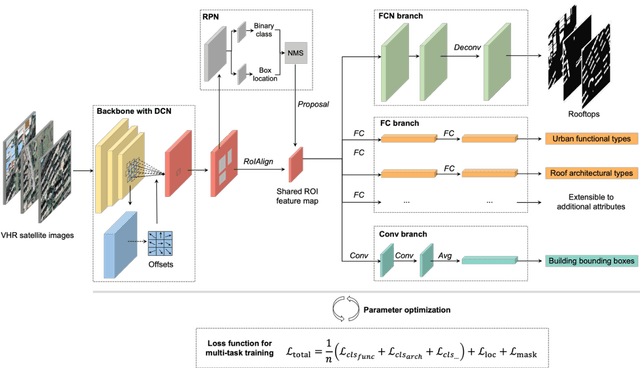

Understanding urban dynamics and promoting sustainable development requires comprehensive insights about buildings. While geospatial artificial intelligence has advanced the extraction of such details from Earth observational data, existing methods often suffer from computational inefficiencies and inconsistencies when compiling unified building-related datasets for practical applications. To bridge this gap, we introduce the Multi-task Building Refiner (MT-BR), an adaptable neural network tailored for simultaneous extraction of spatial and attributional building details from high-resolution satellite imagery, exemplified by building rooftops, urban functional types, and roof architectural types. Notably, MT-BR can be fine-tuned to incorporate additional building details, extending its applicability. For large-scale applications, we devise a novel spatial sampling scheme that strategically selects limited but representative image samples. This process optimizes both the spatial distribution of samples and the urban environmental characteristics they contain, thus enhancing extraction effectiveness while curtailing data preparation expenditures. We further enhance MT-BR's predictive performance and generalization capabilities through the integration of advanced augmentation techniques. Our quantitative results highlight the efficacy of the proposed methods. Specifically, networks trained with datasets curated via our sampling method demonstrate improved predictive accuracy relative to those using alternative sampling approaches, with no alterations to network architecture. Moreover, MT-BR consistently outperforms other state-of-the-art methods in extracting building details across various metrics. The real-world practicality is also demonstrated in an application across Shanghai, generating a unified dataset that encompasses both the spatial and attributional details of buildings.
Meta-learning Control Variates: Variance Reduction with Limited Data
Mar 15, 2023


Control variates can be a powerful tool to reduce the variance of Monte Carlo estimators, but constructing effective control variates can be challenging when the number of samples is small. In this paper, we show that when a large number of related integrals need to be computed, it is possible to leverage the similarity between these integration tasks to improve performance even when the number of samples per task is very small. Our approach, called meta learning CVs (Meta-CVs), can be used for up to hundreds or thousands of tasks. Our empirical assessment indicates that Meta-CVs can lead to significant variance reduction in such settings, and our theoretical analysis establishes general conditions under which Meta-CVs can be successfully trained.